Watch
Incident intake and tiered escalation you can prove
An alert fires. Somebody acknowledges it. An hour later it’s still open, the person who acked it is deep in a rabbit hole, and nobody can say whether it should have gone to the next tier forty minutes ago.
Watch exists to answer one question: did the handoff happen on time, and can we prove it?
An incident enters by webhook (from Sumo Logic, or anything else), becomes a tracked record, and moves through a T1 → T2 → T3 escalation timeline under time-based SLAs. Every transition, manual or automatic, writes the same append-only audit record.
It’s the working implementation of Highway Mode, Race Mode, the operations manual I wrote in June. The manual describes tiers, modes, and when you’re allowed to escalate. Watch makes those rules run.
What it looks like
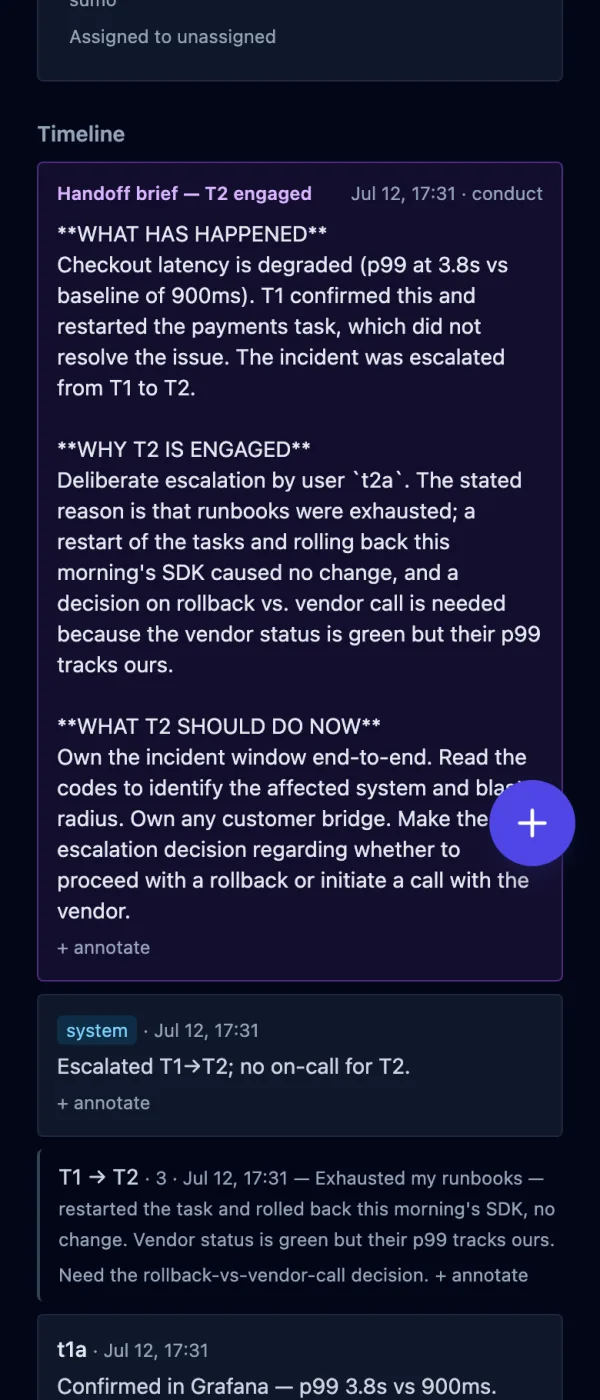
When an incident escalates, the person inheriting it opens the page with three questions: what happened, why am I engaged, and what do you need from me. The timeline used to answer the first one, if you read it bottom-up and in full. Nothing answered the other two.
Now every escalation writes a handoff brief at the top of the timeline with exactly those three sections. A model writes it, locally through Conduct or in the cloud through Bedrock. A deterministic version, assembled from the incident data, works with zero model calls.
You can see a rough edge in that screenshot. The model emits Markdown, and the timeline shows it raw. That’s what the page looks like today.
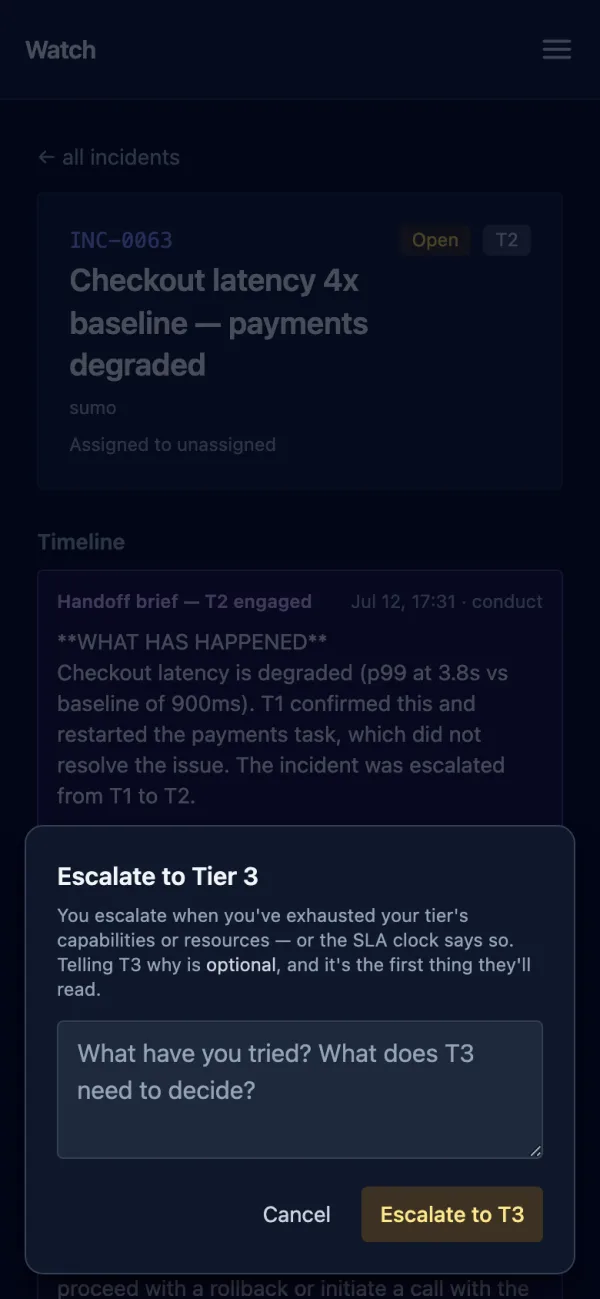
Escalating asks why, but doesn’t make you answer. From the decision record:
Psychologically there’s something helpful about not quite forcing the human to say why — but I want to know they exhausted their resources and are escalating for this reason.
The sheet states the escalation contract at the moment you make the decision. Whatever you type goes into the audit trail and gets quoted verbatim in the next tier’s brief. Resolving works the same way and asks what fixed it. Those two sentences are the most useful lines in any RCA, and now they come from the people who know them, when they know them.
Decisions worth explaining
Watch has 48 architecture decision records. These are the ones that shape what it is.
The timer belongs to AWS, not Django. Each incident gets one Step Functions execution, with a wait state per tier whose timeout is that tier’s SLA. A database-backed scheduler would have been simpler to run. But the escalation timeline is the product, and a Step Functions timer can’t silently fail. It survives any task dying, and a missed escalation surfaces as a failed execution that raises an alarm. That’s sized for fewer than 100 incidents a day, at human pace. At alarm-stream volume it would be the wrong primitive.
Acknowledging doesn’t stop the clock. “I’ve got this” is an event, not progress. An acked incident still escalates at its deadline.
AI classifies, code disposes. The triage assistant returns a classification: whose problem it is, what kind of fault, whether it’s real, and how confident it is. It can’t take an action. The disposition is a pure Python function over a routing matrix in one YAML file that humans review and code executes. Most incidents triage with zero model calls. When the assistant is down, the SLA engine is still the backstop.
Highway and race are state, not a flag. Declaring race mode during a release is an accountable act, with who declared it, why, and when the all-clear came. So mode is an append-only record, and every automated decision takes it as a parameter. The first divergence: in highway mode, a false positive auto-resolves. In race mode, a human confirms it.
Assistants are responders too. Watch is an MCP server with nine tools: list, get, acknowledge, escalate, resolve, and a few more. Tier permissions are enforced on the server, per incident and per call, so an assistant holding T1 credentials gets told “requires T2-or-higher; you hold T1” instead of silently seeing a shorter tool list.
Mobile first, with a gate. The phone layout is the base design, and WCAG 2.1 AA is enforced with zero violations by an axe-core test that runs at pre-commit and in the pipeline.
A bug worth telling
ADR-048 is my favorite, because the system did exactly what it was designed to do and that was the problem.
A missed escalation, a T3 incident nobody resolves in time, deliberately ends its Step Functions execution in failure. That raises an alarm, which is correct: a missed incident should page someone.
I’d also wired that same alarm to gate deploys. Then a seeded demo incident, left alone, walked T1 → T2 → T3, exhausted its SLA an hour and forty-five minutes later, and latched the alarm. Hours after that, a routine deploy rolled itself back. Correct incident behavior blocked a release. In production, a T3 incident nobody got to in time would have frozen all deploys.
The fix was two alarms for two questions. The on-call alarm still fires on a missed escalation. The deploy gate now watches only for the engine’s Lambdas throwing, which is what “this deploy broke something” actually means.
Stack
- Django + DRF as system of record, on ECS Fargate with RDS Postgres. The working surface is server-rendered with HTMX.
- Step Functions + Python Lambdas as the escalation engine. ASL orchestrates, Python decides.
- API Gateway → SQS for intake, acknowledged on enqueue and deduplicated in Postgres, so a webhook retry is a no-op.
- AppConfig feature flags, ntfy paging to whoever is on call, a React status page on CloudFront.
- Terragrunt for everything, across separate AWS accounts with build-once, promote-by-digest delivery.
- OpenTelemetry to Watchtower, my local Grafana stack. Watch is the app; Watchtower is where its telemetry lands.
Releases
Ten tagged releases from July 2 to July 12, 2026, starting a week after the first commit. Each minor release has detailed notes in the repo.
| Version | Date | What landed |
|---|---|---|
| v0.11 | Jul 12 | The assistant tier: operating modes, triage, routing matrix, MCP server, accessibility gate |
| v0.10 | Jul 11 | AI-drafted RCAs through Bedrock or Conduct |
| v0.9 | Jul 7 | Lifecycle reliability and delivery-path doctrine |
| v0.8 | Jul 6 | Problem and RCA records, per-user ingest keys, credential hardening |
| v0.7 | Jul 5 | Public reporting and paging hardening |
Handoff briefs and escalation reasons landed after v0.11 and aren’t in a tagged release yet.
What it isn’t
- Not a ServiceNow replacement. It runs alongside the system of record as the working surface for an investigation.
- Not for alarm streams. One execution per incident is right for slow, human-paced escalation and wrong for machine-generated volume.
- Not autonomous. The assistants advise and write. They never change an incident’s state on their own judgment, except closing a false positive in highway mode, and that’s audited.
What’s next
I’m picking Watch back up. Several things are deliberately deferred until the current loop has run against real incidents: race-mode behavior beyond the false-positive gate, actions for each cell of the triage matrix, and a tagged release for the handoff work.
The code is MIT-0 licensed. Take whatever’s useful.